


More than fifty years later, the Hull incident remains a perfect case study in how official explanations can sometimes strain credulity more than the phenomena they're attempting to debunk.
The object appeared without warning. Witnesses across Hull's working-class neighborhoods - Bransholme, Noddle Hill Way, and beyond - stopped what they were doing and stared. One man, traveling home on the bus, gave an account that still sends chills down the spine of anyone who's felt watched by something inexplicable.
"I could see this thing - it was green and round - following the bus. Every time the bus stopped to pick up passengers, the object stopped as well."
That's not how the moon behaves. That's not how weather phenomena behave. That's not how anything natural should behave.
Soon, Hull's police switchboard lit up with calls. The coastguard reported it. RAF Manby, the nearby air base, confirmed their air crews had observed it too. The object was seen moving slowly out to sea before vanishing. This wasn't a handful of unreliable witnesses or pub-goers spinning tales - this was coordinated observation from trained military personnel, law enforcement, and hundreds of ordinary citizens.
When a helicopter crew went up to investigate the phenomenon, they returned with an explanation that, frankly, insulted everyone's intelligence. According to the official statement, the UFO was simply "a reflection of the Moon on layers of dust contained in mist patches" - a natural phenomenon that "occurs from time to time."
Let's think about that for a moment.
A reflection. On dust. In mist. That followed a bus through multiple stops. That was simultaneously visible across an entire city. That air crews had to fly out over the North Sea to investigate.
This is the sort of explanation that makes you wonder whether authorities think we're stupid or whether they're desperately trying to explain away something they don't understand themselves. It's reminiscent of the infamous "swamp gas" explanation offered by astronomer J. Allen Hynek for the 1966 Michigan sightings - an excuse so transparently absurd it became a cultural punchline.
The 1971 incident wasn't Hull's first brush with the unexplained. The city has a peculiar history of aerial anomalies that stretches back centuries. In June 1801 - yes, 1801 - local and national press reported an unidentified object over Hull that resembled "an immense moon with a black bar across the middle." This wasn't some peasant's superstition; it appeared in contemporary science journals.
Fast forward to 1967. Children in Longhill park reported a cigar-shaped craft descending over the area, leaving burn marks on a hill. Two police officers attended the scene and confirmed the marks, though no aircraft was found. Initially dismissed as children's imagination, the consistency of their separate accounts made investigators reconsider.
In October 1986, twenty people in Bransholme witnessed a moon-shaped object with a curved cone on top and red lights. Three months later, a teacher at Winifred Holtby School had a similar experience. The object remained visible for several minutes before vanishing.
Hull wasn't an isolated hotspot. Throughout 1971, the entire UK experienced a wave of unexplained aerial activity. In January, Pat Otter, assistant editor of the Grimsby Evening Telegraph, claimed that multiple RAF Quick Reaction Alert aircraft were scrambled to investigate mysterious objects over the North Sea - objects that allegedly reached altitudes of 87,000 feet traveling at 4,700 mph. That's faster than the SR-71 Blackbird, which still holds the official speed record.
What makes the Hull incident particularly relevant today isn't just the sighting itself - it's the pattern of official response. In 2024 and 2025, we've seen a dramatic shift in how governments discuss unidentified aerial phenomena, yet the fundamental dynamic remains unchanged: witnesses report extraordinary observations, evidence accumulates, and official explanations often feel designed to placate rather than illuminate.
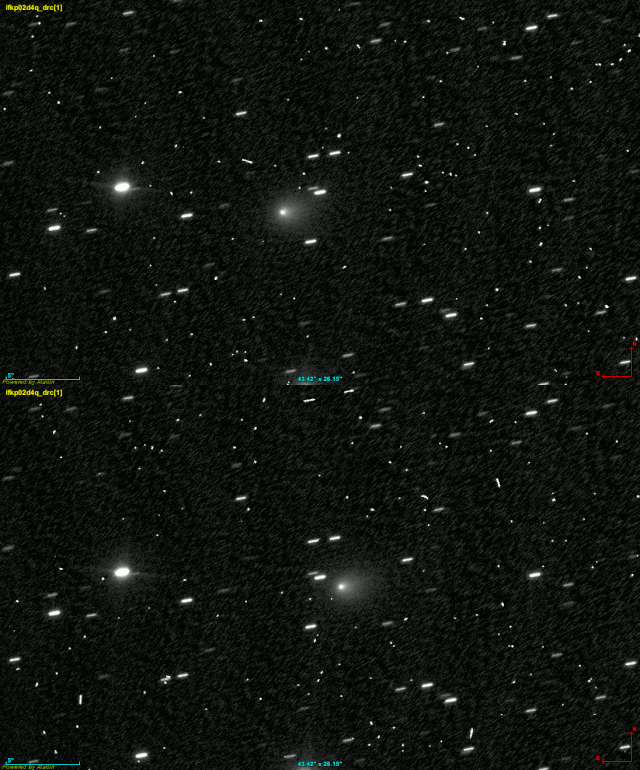
Consider the recent revelations about UAP activity near nuclear facilities. A peer-reviewed study published in Scientific Reports found that mysterious transient objects captured on astronomical plates between 1949 and 1957 were 45% more likely to appear within one day of a nuclear weapons test. That's not anecdote - that's statistical correlation.
Former AATIP director Luis Elizondo has documented repeated instances of UAP operating over restricted nuclear facilities. Witnesses from the USS Theodore Roosevelt carrier strike group reported seeing objects "almost daily" for months during 2014-2015. These weren't glimpses or ambiguous blips - F-18 pilots with aerospace engineering degrees watched disc-shaped objects and cubes-within-spheres maneuvering without visible propulsion.
The parallel is striking. In 1971, multiple trained observers - air crews, police, coastguard - reported coordinated observations of anomalous objects. The official response was to offer an explanation so mundane it bordered on dismissive. In 2025, we have similar observations from credible witnesses, backed by instrumentation, radar, and now peer-reviewed research showing correlations that can't be easily dismissed. And still, the official posture remains one of reluctant acknowledgment at best.
The timing of Britain's 1971 UFO wave is interesting. The UK was a nuclear power in the Cold War, with active weapons programs and Strategic Air Command cooperation with the United States. Hull sits near RAF bases that would have been critical to Britain's nuclear deterrent.
Throughout the Cold War era, UFO sightings clustered around nuclear facilities with suspicious consistency. Malmstrom Air Force Base in 1967. Rendlesham Forest in 1980. The pattern extends globally - from Los Alamos to Savannah River, from Hanford to the Nevada Test Site.
Recent declassified Navy footage, like the USS Omaha UAP encounter, shows objects demonstrating trans-medium capabilities - moving seamlessly between air and water without losing velocity. That's not 1970s eyewitness testimony; that's thermal imaging and multiple sensor confirmation from 2019.
Some researchers, including figures like Marjorie Taylor Greene, have even explored spiritual dimensions to UAP phenomena, suggesting these encounters may transcend purely physical explanations. Whether one accepts such interpretations or not, they reflect humanity's struggle to categorize experiences that don't fit our existing frameworks.
One detail from the Hull incident deserves special attention: the man on the bus who claimed the object followed him, stopping when the bus stopped. This type of seemingly intelligent response to human activity appears repeatedly in UAP reports.
In the Rendlesham Forest incident of 1980, Lt. Col. Charles Halt's audio recording captured real-time observations of an object that appeared to respond to the attention of observers. In the USS Nimitz encounter of 2004, Cmdr. David Fravor described an object that mirrored his flight maneuvers before accelerating away at impossible speeds.
These aren't random atmospheric events. Random atmospheric events don't play follow-the-leader with buses or fighter jets. They don't maintain station above nuclear facilities. They don't appear on multiple sensor systems simultaneously while performing maneuvers that violate our understanding of physics.
The "moon reflecting off dust in mist" explanation for the Hull incident did what it was designed to do - it gave newspapers a conclusion, gave the public something prosaic to believe, and closed the case. But it also did something more insidious: it taught people not to trust their own observations.
When hundreds of people - including trained observers - report seeing something extraordinary, and they're told they actually saw something mundane that bears no resemblance to their description, it creates a kind of epistemic vertigo. You begin to doubt not just what you saw, but your capacity to know what you saw.
This is particularly relevant as we enter an era of increased UAP disclosure. The unprecedented wave of recent UAP sightings has triggered serious discussions about government preparedness and response. We can't have honest investigation if the default posture remains reflexive debunking.
The Hull incident demonstrates several principles that remain relevant today:
First, mass sightings by credible witnesses deserve serious investigation, not reflexive dismissal. When police, military personnel, and hundreds of civilians all report the same phenomenon, the explanation should account for the totality of observations, not cherry-pick details that fit a preferred narrative.
Second, explanations should make sense. An explanation that raises more questions than it answers isn't an explanation - it's deflection. If the moon reflecting off dust in mist could create the effect witnessed in Hull, we should see it regularly. We don't.
Third, patterns matter. Hull's 1971 sighting wasn't isolated. It occurred during a wave of UK sightings, in a region with nuclear-relevant military installations, during the height of the Cold War. Context matters when evaluating extraordinary claims.
Fourth, the quality of witnesses matters. This wasn't a single observer or a group of friends corroborating each other's stories. This was independent observations from trained air crews, coastguard personnel, police officers, and civilians across a wide geographic area. That's the kind of witness testimony that would convict someone in a courtroom.
Here's what we know for certain: Something green, oval-shaped, and apparently responsive to human activity appeared over Hull in September 1971. It was seen by hundreds of people. It was reported by authorities. It prompted military investigation. And the official explanation doesn't remotely match what witnesses described.
We also know that similar objects have been reported consistently for decades, particularly around nuclear facilities, and that modern sensor technology has begun confirming what eyewitnesses have been saying all along: there are objects in our airspace performing maneuvers we can't explain using conventional technology.
The uncomfortable truth is that we may never know what hung over Hull that September night. But we know it wasn't moon glinting off dusty mist. And the fact that authorities offered such an explanation - and expected people to accept it - tells us something important about how these phenomena have been handled throughout modern history.
Maybe it's time we stopped accepting convenient explanations and started demanding honest ones.
The Hull UFO scare of 1971 was either one of the most compelling mass sightings in British history or one of the most successful mass hallucinations on record. Given the number and credibility of witnesses, the involvement of multiple agencies, and the visible consternation of authorities, the hallucination theory seems far less plausible than the simpler explanation: people saw something real, something strange, and something that defied easy categorization.
As we stand in 2025, with peer-reviewed studies confirming statistical correlations between UAP and nuclear activity, with Navy footage showing objects performing impossible maneuvers, and with government officials slowly acknowledging what researchers have documented for decades, perhaps it's worth reconsidering all those "explained" cases from the past.
Maybe the moon reflecting off dusty mist wasn't the explanation for Hull in 1971. Maybe it was the excuse.
And maybe - just maybe - the people of Hull saw exactly what they said they saw: something that shouldn't have been there, something that moved with apparent intelligence, and something we still don't understand more than half a century later.
The green light over Hull wasn't the last mystery. It wasn't even the strangest. But it was a moment when ordinary people looked up and saw the extraordinary - and were told, in effect, to look away.
Some of them never did.