

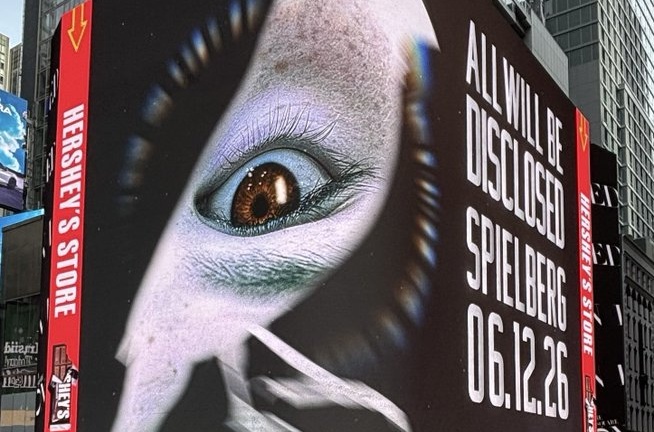
This week, massive billboards appeared in Times Square and across Los Angeles, featuring an image that's decidedly darker than E.T.'s glowing finger. A pale face, an upside-down eye peering through what appears to be a bird-like silhouette, and a tagline that reads: "ALL WILL BE DISCLOSED 06.12.2026." Below that, just one word: Spielberg.
Mysterious billboards for Steven Spielberg's next film have been found in LA and Times Square.
"ALL WILL BE DISCLOSED 06.12.2026" pic.twitter.com/9D5ZLEBubS
— DiscussingFilm (@DiscussingFilm) December 10, 2025
No title. No cast names. No trailer tease. Just a date and a promise—or perhaps a warning.
The timing of this campaign is rather interesting, isn't it? These billboards have appeared just as the film's first trailer is set to debut on 19 December, attached to screenings of James Cameron's Avatar: Fire and Ash. Cinema-goers hoping to catch the latest adventures in Pandora will first be treated to whatever Spielberg's been cooking up in secret for the past year.
The trailer will share screen time with two other highly anticipated previews—Christopher Nolan's The Odyssey and Marvel's Avengers: Doomsday—making Avatar 3 arguably the most essential cinema ticket of the month for anyone who follows these sorts of things.
The billboard imagery itself deserves scrutiny. That upside-down eye could be interpreted any number of ways, but combined with the bird silhouette (some have suggested it's a blue jay, which brings to mind Cold War-era Project Blue Book), the overall effect is distinctly ominous. This is not the wide-eyed wonder of Close Encounters. This feels like paranoia given visual form.
The film has operated under several working titles during production. "Non-View" served as the code name during filming in New Jersey, Atlanta, and Long Island earlier this year. "The Dish" appeared on investor presentations and casting documents. But that "ALL WILL BE DISCLOSED" tagline has convinced many industry observers that the final title will simply be Disclosure.
If that proves accurate, it's a rather on-the-nose choice for a film arriving precisely when congressional UAP disclosure efforts have reached fever pitch. Whether Spielberg's being cheeky or deadly serious remains to be seen.
The film wrapped production in late May 2025, with screenwriter David Koepp confirming the completion. Koepp—who wrote Jurassic Park, War of the Worlds, and Indiana Jones and the Kingdom of the Crystal Skull for Spielberg—has described this project as "a very emotional experience" that combines "vast spectacle with really honest human emotion." Josh O'Connor, one of the film's stars, has compared it to "old-school" Spielberg, specifically citing E.T. and Close Encounters as touchstones.
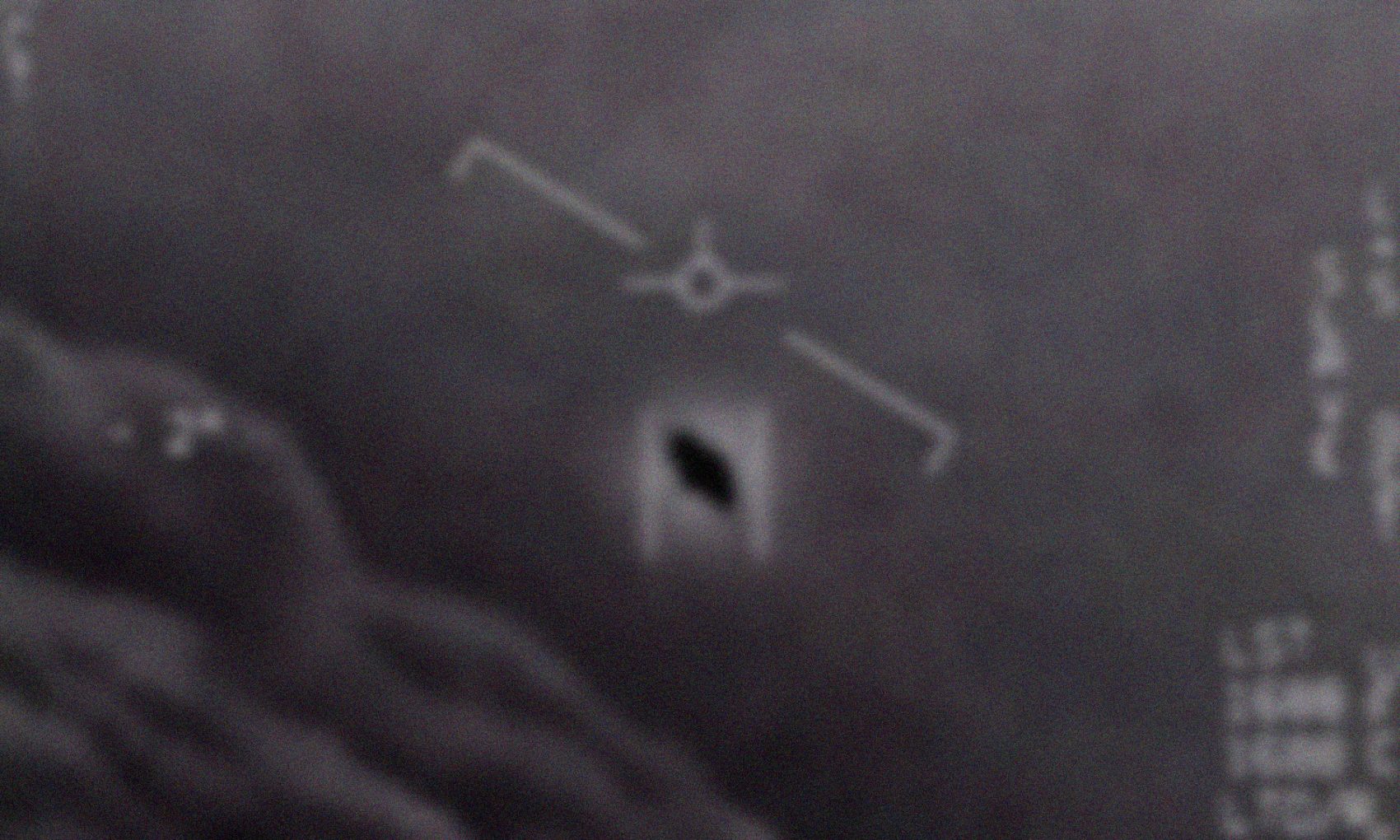
Whilst Spielberg's marketing team has been pasting mysterious eyeballs across Times Square, Congress has been rather busy making the original subject matter of his film increasingly relevant.
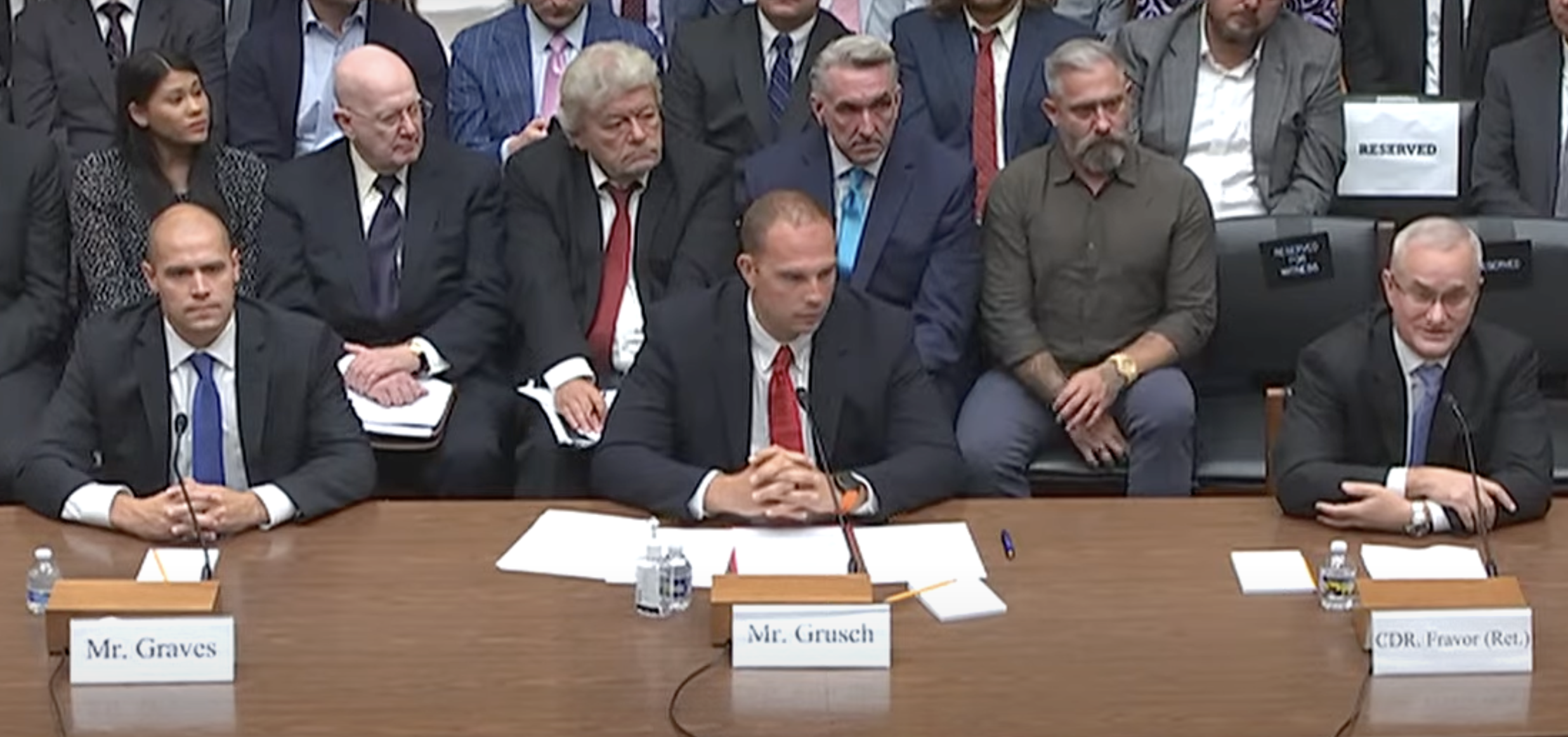
In September 2025, the House Oversight Committee's Task Force on the Declassification of Federal Secrets held hearings titled "Restoring Public Trust Through UAP Transparency and Whistleblower Protection." UAP journalist George Knapp testified that the public has been told "there's nothing to worry about" since the late 1940s, whilst witnesses pressed for standardised procedures for capturing sensor data when military personnel encounter unexplained phenomena.
Just this week, the conferenced version of the fiscal year 2026 National Defense Authorization Act included three UAP-related provisions. One requires the Pentagon to brief lawmakers on all UAP intercepts conducted by North American defence commands since 2004. Another directs the All-Domain Anomaly Resolution Office (AARO) to account for security classification guides applied to UAP information—addressing long-standing concerns about overclassification and suppression of previously unclassified material.
Representative Eric Burlison's UAP Disclosure Act of 2025, submitted as an amendment to the NDAA, would establish an independent UAP Records Review Board and require public disclosure of UAP records within 25 years unless the President certifies a national security reason for delay. The measure would also prohibit destruction or alteration of UAP records—a rather telling inclusion, that.
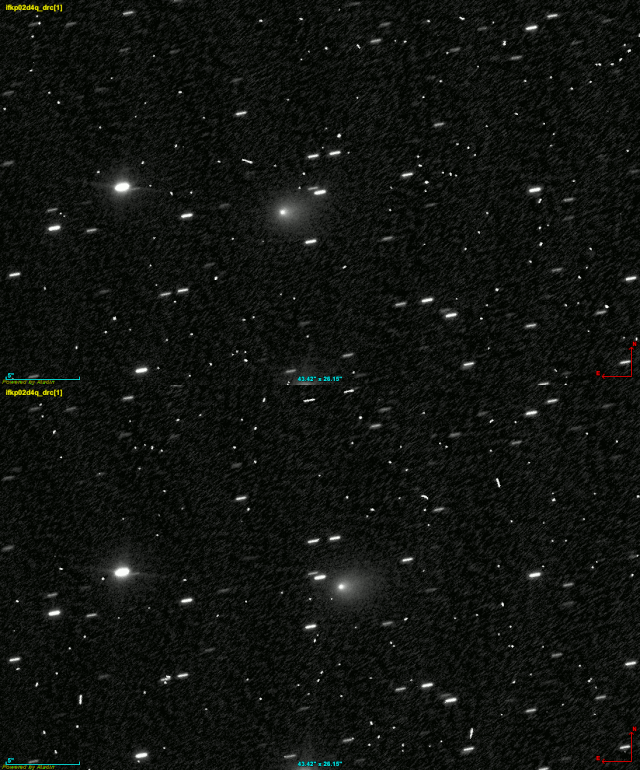
Representatives Anna Paulina Luna and Tim Burchett continue pushing for transparency, with Luna demanding NASA release classified 3i Atlas images. The frustration amongst lawmakers is palpable. As one witness testified during the September hearings, when asked why the Department of Defense overclassifies UAP information: "There's the philosophical defense that the DoD and the intelligence community are solution-oriented and when you don't have answers it is a really tough spot to be in." Translation: easier to be quiet when you're clueless.
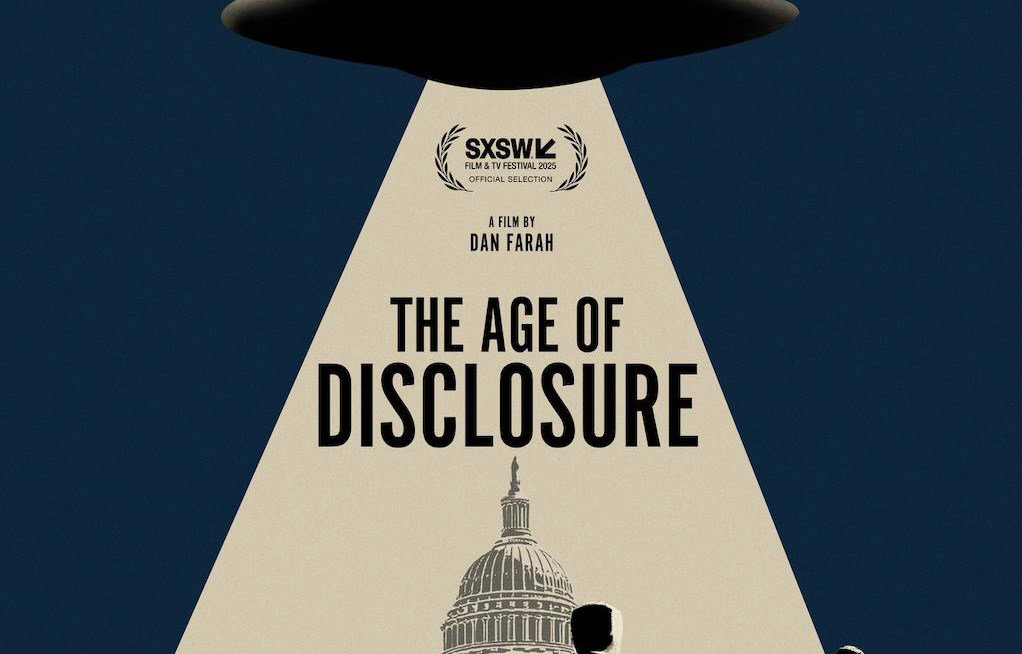
Here's where things get properly meta. Dan Farah's documentary The Age of Disclosure, which examines the same UAP disclosure efforts that Spielberg's film appears to dramatise, has become a genuine phenomenon. Within 48 hours of its release on Prime Video, it broke the platform's record for highest-grossing documentary, surpassing Free Solo.
The film features interviews with Secretary of State Marco Rubio, Senators Kirsten Gillibrand and Mike Rounds, former Director of National Intelligence James Clapper, and numerous other government officials. Senator Rubio is quoted in the documentary saying: "Even presidents have been operating on a need-to-know basis but that begins to spin out of control."
The documentary debuted at number one and number two on Prime Video's charts (purchase and rental respectively) for the first eight days of its release, outperforming major studio titles from Warner Bros, Universal, Disney, and Paramount. It's now in the running for Academy Award consideration, with shortlist voting extending until mid-December.
So the real-world documentary about UAP disclosure is breaking records whilst Spielberg prepares to release a fictional dramatisation of... what, exactly? UAP disclosure? Government conspiracy? The intersection of both?
The confirmed cast remains impressive: Emily Blunt, Josh O'Connor, Colin Firth, Colman Domingo, Wyatt Russell, Eve Hewson, and Henry Lloyd-Hughes. Cinematographer Janusz Kamiński is behind the camera, as he's been for most of Spielberg's work since Schindler's List. John Williams returns to compose the score—their 30th collaboration.
Footage shown during a Universal Pictures event in June revealed action sequences including chase scenes, mysterious black cars (very Men in Black), and a dramatic car-train crash escape involving Blunt's character. Colin Firth was described as looking "sinister and well-suited as a leader in some kind of underground workspace that resembles a NASA control room."
The release date has shifted slightly—originally scheduled for 15 May 2026, it's now locked in for 12 June 2026, placing it squarely in summer blockbuster territory. Spielberg essentially invented the summer blockbuster with Jaws, so there's a certain poetry to him returning to the format with another film about things lurking just beyond our understanding.
Step back for a moment and consider the convergence happening here. Congressional hearings intensifying. Whistleblowers coming forward despite career risks. Classification battles playing out in public. A documentary about UAP disclosure breaking streaming records. And Spielberg—the director who arguably did more than anyone to shape how we imagine alien contact—returning to the subject with what appears to be a darker, more paranoid vision.
Is this simply savvy timing? The culmination of decades of interest in the subject? Or is there something else at play?
Spielberg himself has said publicly that he's concerned about the "secrecy and lack of transparency" surrounding UAP sightings, stating that "something is going on." He's been following the congressional hearings and whistleblower testimonies. This isn't a director jumping on a trending topic—it's someone who's been circling this subject for nearly 50 years, watching the conversation shift from ridicule to legitimate national security concern.
That billboard tagline—"ALL WILL BE DISCLOSED"—reads differently depending on your perspective. Is it a promise? A threat? A commentary on our current moment? Or simply clever marketing designed to capitalise on the zeitgeist?
We'll get our first proper look at the film on 19 December when the trailer debuts with Avatar: Fire and Ash. Expect online dissection within minutes, frame-by-frame analysis within hours, and approximately seventeen thousand think pieces by the weekend.
The film arrives on 12 June 2026—roughly six months away. Congressional UAP investigations show no signs of slowing. The cultural conversation around these phenomena has fundamentally shifted from mockery to genuine curiosity mixed with concern. And Spielberg, ever the showman, has positioned his film at the precise intersection of pop culture and political reality.
Whether the film delivers answers, raises more questions, or simply provides two hours of pulse-pounding entertainment remains to be seen. But that billboard in Times Square, with its inverted eye and promise of disclosure, suggests Spielberg's not interested in comfortable nostalgia.
This isn't going to be another heartwarming tale of a lonely boy and his alien friend. This feels like something else entirely—something darker, more complicated, and perhaps uncomfortably close to whatever truth actually lurks behind all those congressional testimonies and classified briefings.
The question isn't whether Spielberg will deliver a compelling film. The question is whether we're ready for what he has to say.
I'll be queuing for tickets the moment they go on sale. You should too.